
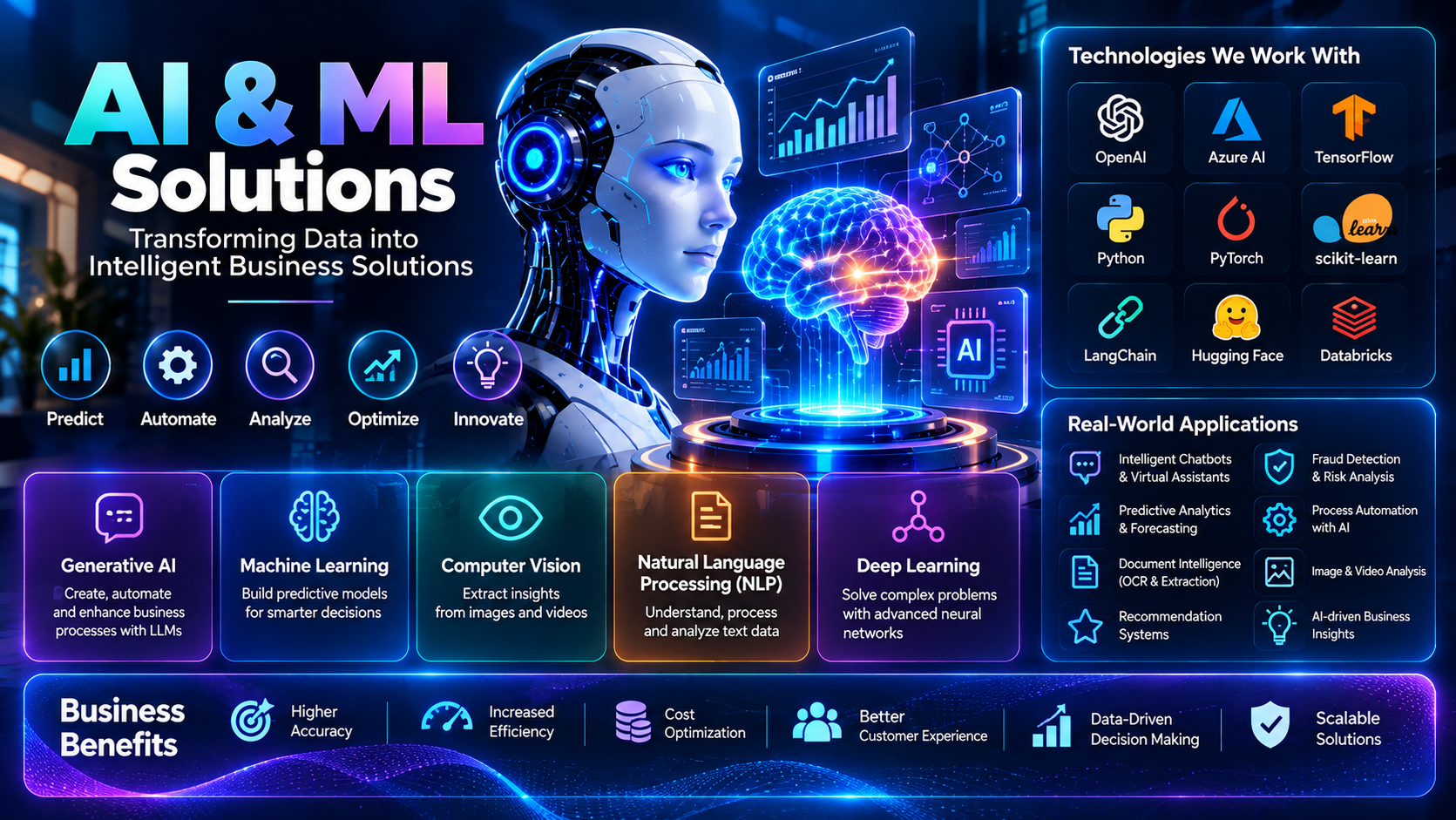
AI-ML Solutions
Predictive Analytics
Forecasting for demand, inventory and risk, built on your own historical data.
Explore →Intelligent Process Automation
Removing repetitive manual work from workflows that don't need a human in the loop.
Explore →NLP & Document Extraction
Pulling structured data out of documents, forms and unstructured text automatically.
Explore →Custom AI Model Development
Models tuned to your own data and use case, not a generic off-the-shelf tool.
Explore →The fields our AI-ML work draws on
Machine Learning
Models that improve from exposure to data rather than being explicitly programmed for every case — spotting patterns and making decisions that adapt as more data comes in. John McCarthy, who coined the term artificial intelligence, described the broader field as "the science and engineering of making intelligent machines, especially intelligent computer programs."
Natural Language Processing
The discipline behind getting a computer to actually understand text or speech — not just match keywords, but interpret meaning and respond the way a person would. It's what lets a system read a document or a message and extract what it's really saying.
Data Science
The broader practice of pulling meaningful insight out of both structured and unstructured data — combining analysis, algorithm design and engineering to turn raw information into something a business can actually act on.
AI-Based Algorithms
The step-by-step logic underneath any intelligent system — a defined set of rules a computer follows to reach a decision, in the same way a recipe defines steps toward a dish. Once defined, it becomes the working part of a system that learns and adapts on its own.