
Healthcare Item Master Data
Deduplication
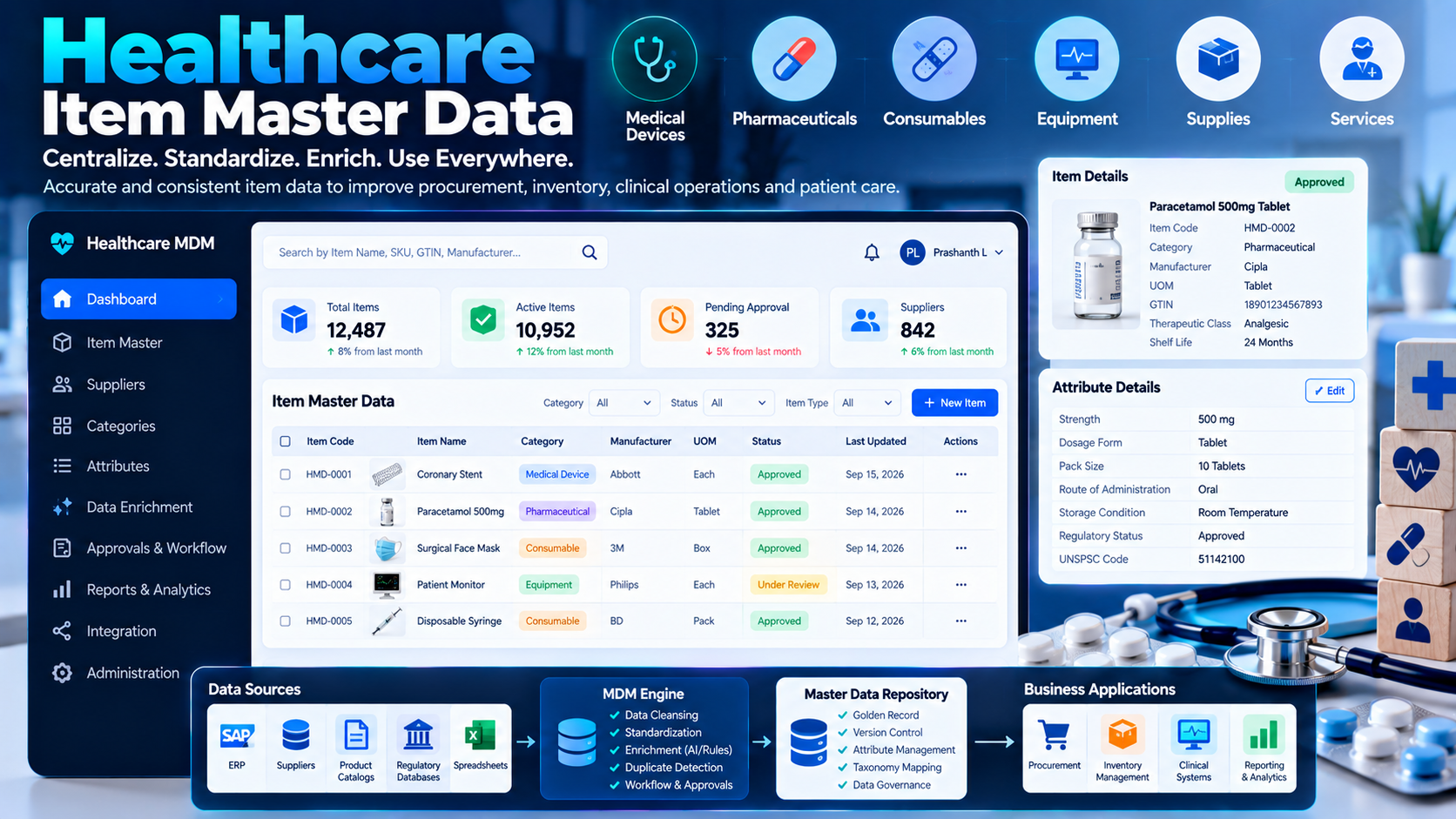
Ordering the same Med-Surg consumable twice because it exists as two separate item records is a common and expensive problem in hospital supply chains — it quietly inflates inventory counts, ties up budget on stock you already had, and makes usage reporting unreliable. Deduplication finds and resolves these duplicate records before they affect a purchase order. Rather than relying on an exact-text match — which misses records worded even slightly differently — the process compares items across multiple fields at once, so two records describing the same consumable get flagged and merged, even when nobody entered them the same way twice.
Standardization & Golden Records
A hospital's item master accumulates inconsistency over time as different staff, departments and acquired facilities enter data using their own conventions. Standardization brings uniformity across the master so every record follows the same rules and structure, consolidating scattered, inconsistent entries into a single trusted "golden record" for each item. This matters well beyond tidiness — procurement, reporting and system integration all depend on data being structured the same way every time. A golden record is what lets your team pull a reliable spend report or push clean data into another system without a manual reconciliation step first.
Item Master Data Classification
Classifying items correctly is what makes spend analysis and reporting possible at scale. We classify item master data against UNSPSC, HCPCS and SIC — the standards most healthcare organizations already report against — and we're equally comfortable working within a customer's own in-house taxonomy where one exists. UNSPSC in particular is the classification most of our healthcare customers rely on for spend visibility: a four-level hierarchy coded as an eight-digit number, with an optional fifth level available for extra granularity. Getting this classification right the first time is what lets your team later ask "what did we spend on X category this year" and actually get a trustworthy answer.
SNOMED CT
Beyond product-spend classifications like UNSPSC, clinical item data often needs to map to SNOMED CT — the clinical terminology standard used across electronic health records. We map item and supply data to SNOMED where it needs to connect with clinical documentation, so procurement data and clinical records speak the same language instead of living in separate systems that don't reconcile.
LOINC
For lab and diagnostic-related items, LOINC coding identifies tests, measurements and observations in a standard, interoperable way. We apply LOINC classification where item records intersect with lab and diagnostic workflows, so data exchanged with lab systems and external partners lines up correctly the first time, without a manual mapping exercise on either end.
GTIN Extraction & Valuation
GTIN barcodes carry manufacturer, packaging and unit-of-measure information that's often sitting unused in scanned data. We extract GTIN data directly from source documents and barcodes, validate it against item records, and feed it into inventory valuation — so pricing and stock counts are grounded in verified barcode data rather than manually entered figures that can drift out of sync.
Tooling for MDG
Classification and enrichment are only useful if they plug into the governance workflow your team actually runs on. We build and configure the supporting tooling for your Master Data Governance process — validation rules, approval routing and audit tracking — so classified, enriched healthcare item data flows into MDG without a separate manual handoff step.
Item Master Data Enrichment
A bare item record with just a part number and a short description doesn't give staff enough to work with. Enrichment fills in the gaps — adding technical specifications, usage instructions, classification codes, storage information and item images where they're missing, and identifying and fixing typos, incomplete fields, and redundant or incorrect product details along the way. We also flag items that have been discontinued or are no longer supplied by the manufacturer, so they stop showing up as orderable when they're not, and we can generate abbreviated descriptions formatted to fit your specific ERP's field-length rules — so the data isn't just accurate, it's usable in the system you actually run.
Trading Data Validation
Vendor and manufacturer records drift the same way item descriptions do — naming inconsistencies, duplicate entries, and unrecorded acquisitions all accumulate over time. We identify and resolve these issues, normalizing and standardizing names while retaining merger and acquisition history and adding parent/child relationships wherever one entity owns another. On the purchasing side, we review unit-of-measure and packaging strings for every item to check they're accurate and consistent, and capture GTIN barcode data wherever it's available. Together, this is what prevents an order built off a mismatched UOM from turning into a twelve-times overstock — or an empty shelf.
Inventory Valuation Support
Balancing inventory between stock-outs and expired stock requires more than a periodic count — it requires understanding levels by cost center, item category, and active-versus-expired status, and being able to see performance trends over time. Our inventory valuation team handles this analysis directly, including cost UOM determination and cost center validation. We help update inventory values using Kanban and PAR methods, giving your supply chain team a clearer, more current picture of where stock actually stands. The end result is fewer emergency reorders, less capital tied up in excess stock, and a valuation process your finance team can actually rely on.